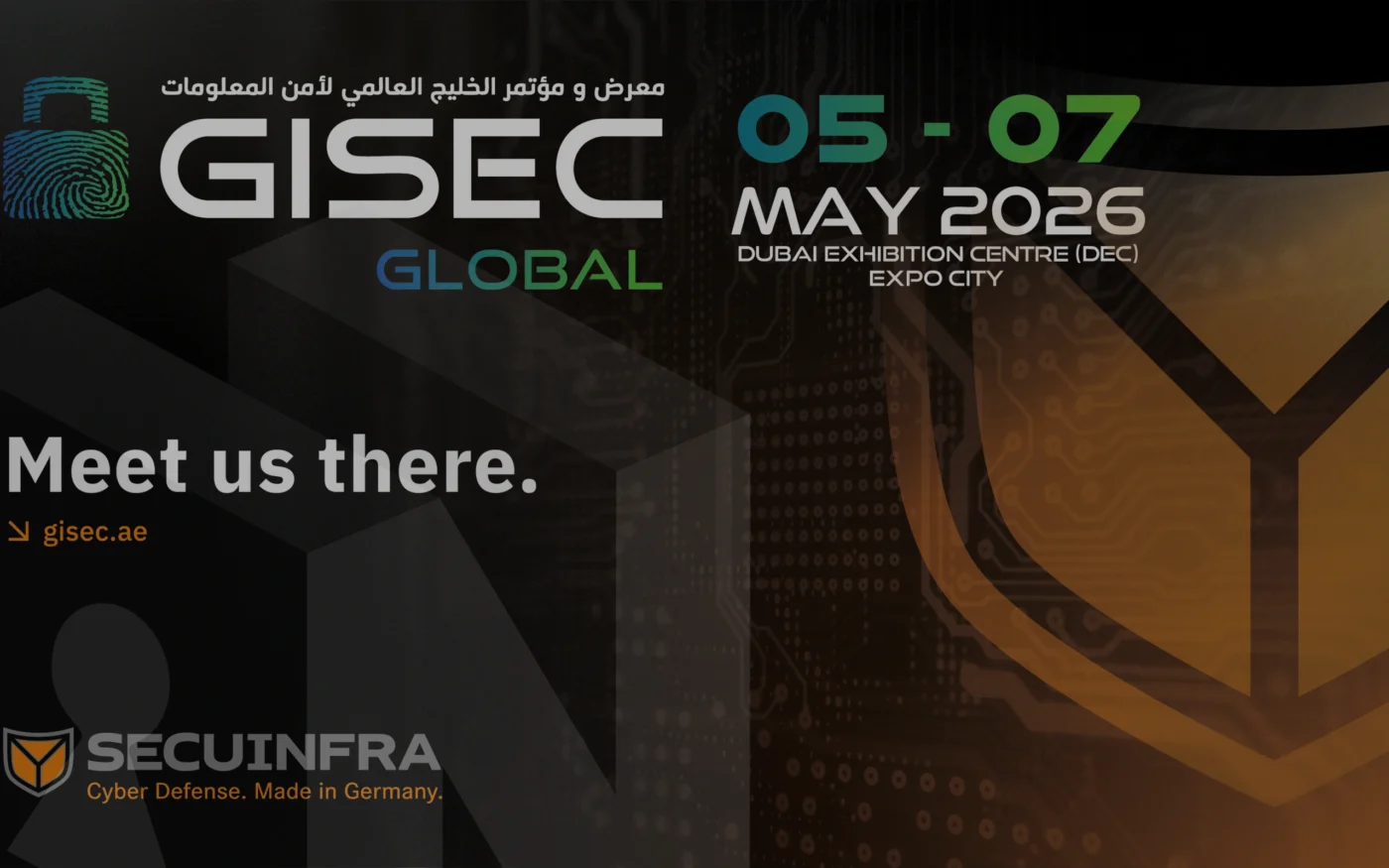
When GISEC Global 2026 opens at the Dubai Exhibition Centre on 5 May, organisers expect 25,000+ information-security professionals from more than 180 countries, 750+ exhibiting brands, and over 300 hours of stage content across six specialised zones. That footprint now rivals RSA Conference and Black Hat in scale — and it is not happening in Silicon Valley, Tel Aviv, or London. It is happening in Expo City, a forty-minute drive from the world’s largest single-site solar park, inside a region that five years ago barely registered on global cybersecurity conference maps.
The shift is not cosmetic. Behind the exhibition floor sits a regional market that Mordor Intelligence values at USD 20.55 billion in 2025, projected to reach USD 40.97 billion by 2030 at a 14.8% CAGR, driven by sovereign-cloud mandates, mega-project security requirements, and a threat environment where Dr. Mohamed Al Kuwaiti, head of the UAE Cyber Security Council, reports 90,000 to 200,000 breach attempts against UAE infrastructure every single day. GISEC is the visible surface of something larger: a deliberate, well-funded push to turn the Gulf into a cybersecurity centre of gravity.
What GISEC 2026 Actually Looks Like on the Ground
GISEC Global runs 5–7 May 2026 at Dubai Exhibition Centre in Expo City, with a September edition scheduled for 21–23 September at the same venue. The May event is the flagship. Organisers describe 150+ startups, 750+ global cybersecurity brands, and zones including the Global Cyber Drill, Critical Infrastructure Zone, Dark Stage, Startup Grid, and Dubai Cyber Challenge.
The content architecture is worth dwelling on because it reveals regional priorities. The Critical Infrastructure Stage foregrounds oil, gas, telecom, and law enforcement — sectors that have absorbed the brunt of state-sponsored activity across the Gulf. X Labs runs live hacking demonstrations against simulated banking infrastructure and identity platforms. Inspire Women in Cyber is a recurring track; Saudi women already represent 32% of the Kingdom’s cybersecurity workforce, exceeding global figures, and the conference programming reflects that reality rather than treating it as aspirational.
GISEC is organised by Dubai World Trade Centre with backing from the UAE Cyber Security Council. That pairing — commercial trade body plus federal cyber authority — matters. It means procurement conversations at the booth level run in parallel with sovereign policy announcements on the Government Stage. CISOs from Fortune 500 companies, Gulf government buyers, and law-enforcement delegations share the same coffee queues.
The Threat Environment That Built the Market
Cybersecurity hubs form where three things converge: large digital attack surfaces, sustained adversarial pressure, and governments willing to spend. The Gulf has all three.
Al Kuwaiti’s Cyber Security Council disclosed in February 2026 that state-sponsored and APT groups account for 71.4% of tracked threat actors (15 of 21 groups) targeting the UAE, while eCrime and hacktivist groups each account for 14.3%. That ratio is almost inverted from what Western enterprises face, where criminal ransomware crews dominate threat telemetry. In the Gulf, the baseline assumption is nation-state. Named actors working the region — APT33, APT34, MuddyWater, and CyberAv3ngers — overlap with Iranian intelligence services and have maintained long-dwell access campaigns against energy and utility operators.
The Lemon Sandstorm campaign against Middle East critical infrastructure illustrated the pattern. Iranian-linked actors maintained covert access to regional operational networks for up to 24 months, exploiting VPN flaws across utilities. That is not a smash-and-grab. That is deliberate, patient, strategic positioning — the kind of intrusion that turns cyber spending from discretionary to mandatory overnight.
The attack mix that does land is also distinct. Defacement accounted for 38.3% of 2026 incidents against UAE entities, followed by data leaks at 25.8%, data breach at 13.3%, initial access at 10.2%, ransomware at 7.8%, and DDoS at 4.7% . Defacement is unusual at that share — it suggests a heavy hacktivist and information-operations component alongside the APT traffic. The council has tied much of that activity to regional geopolitical tensions and AI-enabled disinformation across North Africa, the Gulf, and broader Middle East information spaces.
Saudi Arabia is absorbing comparable pressure. Between January and June 2025, Saudi Arabia recorded 270,179 attempted cyber attacks, the highest frequency in the Gulf. That volume has forced a particular kind of market maturation: regional enterprises now budget for managed detection and response, behavioural analytics, and OT monitoring as baseline line items, not bolt-ons.
Vision 2030, NCA, and the Saudi Hub Play
If the UAE’s pitch is “we run the event,” Saudi Arabia’s is “we are building the industry.” The Kingdom’s National Cybersecurity Authority (NCA), established in 2017 and reporting into the Council of Ministers, has pursued a two-track strategy: protect first, then commercialise.
The protection layer is the Essential Cybersecurity Controls (ECC) framework, mandatory for government entities and operators of critical national infrastructure. The ECC sits alongside sector-specific regimes — the Saudi Central Bank (SAMA) cybersecurity framework for financial institutions and the Communications, Space, and Technology Commission (CST) controls for telecoms. Saudi regulations introduced in December 2024 stipulate penalties of up to SAR 25 million for non-compliance, effectively assuring multi-year procurement pipelines.
The commercialisation layer is newer and more revealing. NCA’s 2025 economic indicators report quantifies it: the Saudi cybersecurity market reached SAR 15.2 billion in 2024, growing 14% year-on-year, with private-sector spending at SAR 10.3 billion (68% of the market) and 21,700 cybersecurity specialists in the workforce. NCA’s CyberIC Innovation programme, run in partnership with NEOM, funds startups through market-entry and scale phases; the Saudi Information Technology Company (SITE) acts as the Kingdom’s strategic technical partner on everything from threat intelligence to sovereign security tooling.
The international validation matters for hub status. Saudi Arabia was classified as a Role-Model country in the highest category of the ITU Global Cybersecurity Index 2024, and the UAE’s position in the same index climbed from 33rd in 2019 to the top “Pioneering Model” tier by 2024. Those rankings translate into procurement confidence when foreign enterprises choose where to headquarter regional security operations.
What Makes the Hub Claim Credible — and Where It Strains
Several structural factors genuinely distinguish the Middle East cybersecurity market from competing regions.
Concentrated buyer power. Sovereign wealth funds, state-owned oil and utility operators, and federal cyber authorities control an unusual share of regional cyber spending. For vendors, that means fewer, larger deals and closer policy alignment than in fragmented markets like Europe or Southeast Asia. Check Point’s April 2025 multi-partner partnership with AWS, Wiz, Radware, and TechBridge MEA to expand AI-driven security capabilities in the UAE is the template: platform vendors align around sovereign priorities rather than competing at the edges.
Mega-project gravity. NEOM, the Red Sea Project, Expo City, and Qatar’s continuing infrastructure build-out create security requirements from the design stage, not as retrofits. Dubai’s smart city programme alone deploys millions of IoT-enabled devices across transport, utilities, and emergency response — each one a new attack surface requiring monitoring, segmentation, and supply-chain assurance.
Regulatory velocity. The UAE’s Federal Decree-Law No. 45/2021 on personal data protection, the UAE NESA standards, Saudi Arabia’s ECC and PDPL, Qatar’s National Cybersecurity Strategy 2024–2030 targeting an USD 11 billion market by 2027 — the regulatory cadence is faster and more prescriptive than in most Western jurisdictions. Compliance-led spend is sticky.
Visible local champions. Help AG (UAE), CPX (UAE), and sirar by stc (Saudi Arabia) have matured from reseller-integrator roles into credible regional platforms offering managed detection, threat intelligence, and sovereign cloud security. Their presence gives international vendors real partners, and gives regional buyers alternatives to pure-play Western procurement.
Workforce: 21,700 specialists, 32% women
Authority: National Cybersecurity Authority (NCA)
Frameworks: ECC, SAMA, CST, PDPL
ITU GCI 2024: Role-Model tier
2026 confirmed incidents: 128 (YTD Feb)
Authority: UAE Cyber Security Council
Frameworks: NESA, IAS, Federal Decree-Law 45/2021
ITU GCI 2024: Pioneering Model tier
Roles density: 434 per 100k residents
Frameworks: Central Bank, MOICT
Focus: Managed security services
2030 projection: USD 26–41B
CAGR range: 9.2%–14.8%
Avg breach cost: USD 7.46M (among highest globally)
Where the hub narrative strains is on talent. IDC Middle East reported in 2023 that 64% of regional enterprises cite skill shortages as a major barrier to implementing advanced security like XDR and zero trust. In the UAE, 87% of enterprises face challenges recruiting skilled professionals despite high salary offerings; Qatar records 434 cybersecurity roles per 100,000 residents, yet demand continues to outpace supply. The response — Khalifa University Cybersecurity Academy in Abu Dhabi, NCA’s push to train 40,000 professionals, mandatory AI and cybersecurity curriculum in UAE government schools — is substantive but will take a decade to resolve. For now, managed security service providers are absorbing demand that in-house teams cannot.
The other strain is fragmentation. Only six of the 17 countries in the Middle East have enacted dedicated cybersecurity legislation with enforceable penalties, while nations like Yemen and Syria continue to rely on outdated telecom or criminal codes. Regional cooperation frameworks exist — the Arab Convention on Cybercrime, OIC coordination, bilateral threat-intelligence pacts like the UAE Cyber Security Council’s Group-IB agreement covering 15 jurisdictions — but harmonisation is uneven. A Dubai-headquartered SOC watching infrastructure in Cairo, Amman, and Riyadh still navigates three different legal regimes on incident disclosure alone.
Why the Conference Itself Matters to the Hub Thesis
Trade shows do not make hubs. Hubs make trade shows. But a conference at GISEC’s scale creates compounding effects that accelerate an existing trajectory.
Procurement concentration. Three days, 25,000 attendees, and the entire regional buyer-side present means vendors compress a year of business development into a week. Startup pitch tracks like Unlock Pitch Competition at GITEX North Star put early-stage companies in front of Gulf sovereign investors directly.
Policy signalling. The UAE Cyber Security Council uses the Government Stage to announce strategy updates, regulatory changes, and international partnerships. Those announcements set procurement direction for the following fiscal year across federal entities and the critical infrastructure sectors they regulate.
Ecosystem visibility. The Dark Stage — closed-door threat-intelligence briefings for law enforcement and vetted CISOs — is the kind of track that typically happens at invitation-only events like SANS or FIRST conferences. Running it alongside an open expo is unusual and signals confidence that the ecosystem is mature enough to host both registers simultaneously.
Talent funnelling. CTF School of Cyber, Dubai Cyber Challenge, and the Global Cyber Drill all function as talent-development vehicles. Regional universities and government talent programmes recruit from the winners.
AI, Deepfakes, and the Defensive Posture
Generative AI occupies an outsized share of GISEC 2026’s programming for a reason. Al Kuwaiti has been blunt: “It’s no longer a case of seeing is believing”, speaking to the proliferation of deepfake video impersonating public figures, executives, and financial authority figures to drive fraud and market manipulation. The Cyber Security Council now tracks fabricated video as a distinct threat category alongside ransomware and APT activity.
The defensive response has two tracks. The first is technical: regional SOCs are deploying behavioural biometrics, liveness detection, and AI-powered forensic tooling to authenticate identity at speed. Surveys show 99% of UAE organisations acknowledge AI’s resilience benefits, and 49% plan extra budgets explicitly for analytics use-cases. The second is societal: mandatory AI and cybersecurity curricula across UAE government schools, national awareness campaigns, and Al Kuwaiti’s repeated framing that “we need society to be our first line of defence.”
That second track is where the region’s approach diverges most visibly from Western norms. Gulf governments treat information-operations resilience as a national-security competency rather than a platform-moderation problem — the same agencies buying EDR tooling are running citizen-awareness campaigns, and the conference circuit reflects that integration.
Frequently Asked Questions
Is GISEC bigger than other regional cybersecurity events? Yes. At 25,000+ professionals and 750+ exhibiting brands, GISEC now ranks as the world’s third-largest dedicated cybersecurity event and the largest in the Middle East and Africa. It is the only event of comparable scale outside the US and Europe.
Why two GISEC events in 2026? Organisers have scheduled editions in May (5–7) and September (21–23) at the Dubai Exhibition Centre. The May event is the flagship; the September edition is a newer addition responding to demand from exhibitors and the scale of the regional buyer community.
Is the Middle East actually a cybersecurity hub, or just a big spender? Both. Spending drove the initial market formation, but indigenous capability is now accumulating — local managed security providers like Help AG, CPX, and sirar by stc, Saudi startup funding through CyberIC, a growing workforce, and top-tier ITU rankings. The hub claim is no longer purely aspirational.
Is the region’s security spending sustainable if oil revenue drops? Cybersecurity budgets in the Gulf are now locked into regulatory compliance pipelines, critical-infrastructure protection mandates, and Vision-programme targets that are treated as national-security commitments rather than discretionary IT spend. The spending is structurally less cyclical than other technology categories.
Where This Goes Next
The useful question is no longer whether the Middle East has a credible cybersecurity sector. It does. The question is whether the regional hub can develop enough indigenous research-and-development depth to stop importing the products it increasingly regulates. Saudi Arabia’s CyberIC programme, Khalifa University’s academic push, and the startup density on display at GISEC suggest the answer is slowly becoming yes — but the R&D base remains thinner than the procurement base, and the talent gap is a decade-long problem that no conference can close.
For CISOs, vendors, and investors, GISEC Global 2026 is the most efficient three days of regional context available anywhere. For policymakers watching from the outside, it is a reminder that cybersecurity centres of gravity now plural-form: Washington, Brussels, Tel Aviv, Singapore, and increasingly, Dubai and Riyadh.