

Organizations today operate in an environment where cyber threats evolve constantly, regulatory pressure continues to grow, and digital infrastructure becomes more complex each year. To reduce risk and maintain resilience, companies rely on structured security assessments. Two of the most common approaches are penetration testing and security audits.
Although these terms are sometimes used interchangeably, they serve different purposes and follow distinct methodologies. Understanding how they differ—and how they complement each other—is critical for building an effective cybersecurity program.
This guide explains what each approach involves, how they differ, and when organizations should use each method.
What Is Penetration Testing?
Penetration testing, commonly called pentesting, is a controlled simulation of cyberattacks conducted to identify vulnerabilities attackers could exploit.
Security professionals, often referred to as ethical hackers, attempt to breach systems, networks, or applications using techniques similar to real-world attackers. The objective is not merely to find weaknesses but to demonstrate how those weaknesses could be exploited and what impact a breach might have.
In simple terms, penetration testing answers one central question:
“If someone attacked us today, what could they break into?”
Pentesting focuses on technical exploitation, not policy compliance.
What Is a Security Audit?
A security audit takes a broader, governance-focused approach. Instead of simulating attacks, auditors review whether an organization’s policies, controls, and procedures are properly designed and followed.
Security audits evaluate whether security practices align with regulatory requirements, industry standards, or internal policies. Auditors examine documentation, system configurations, and operational processes to determine whether security controls are functioning as intended.
A security audit essentially asks:
“Are we managing security correctly according to accepted standards?”
Where penetration testing stresses defenses, audits examine structure and discipline.
How Penetration Testing Works in Practice
A penetration test usually follows a structured process.
First, testers define scope and objectives, ensuring testing does not disrupt business operations. Next, they gather information about systems, identifying potential entry points. Automated and manual techniques are then used to locate vulnerabilities.
Testers attempt to exploit discovered weaknesses, simulating what attackers could achieve. After gaining access, they evaluate how far they could move within the environment and what data or systems could be compromised.
The final deliverable is a detailed report explaining vulnerabilities, exploitation paths, and remediation recommendations.
Many organizations now also conduct follow-up testing after fixes are applied.
How Security Audits Are Conducted
Security audits involve reviewing evidence rather than attacking systems. Auditors examine security policies, employee procedures, access controls, configurations, and compliance documentation.
They compare the organization’s practices against recognized frameworks or regulatory obligations, identifying areas where controls are missing, outdated, or improperly implemented.
Audits usually conclude with a report outlining compliance gaps and improvement recommendations, followed by remediation tracking to ensure corrective actions are completed.
Core Differences at a Glance
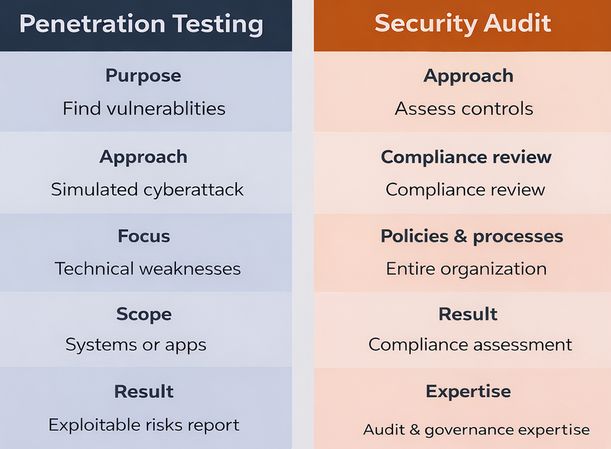
A comparison helps clarify the distinction.
| Area | Penetration Testing | Security Audit |
|---|---|---|
| Purpose | Identify exploitable vulnerabilities | Verify policies and controls |
| Approach | Simulated attack | Compliance and governance review |
| Focus | Technical weaknesses | Organizational processes |
| Scope | Specific systems or applications | Organization-wide security |
| Result | List of exploitable risks | Compliance and control assessment |
| Expertise | Ethical hacking skills | Compliance and risk management expertise |
In short, pentesting shows how defenses fail, while audits show whether defenses are properly managed.
When Should Organizations Use Each?
The decision is not usually either-or. Most mature organizations use both approaches for different purposes.
Penetration testing is particularly useful when organizations deploy new systems, undergo infrastructure changes, or need to validate technical defenses against real attackers.
Security audits are often required for regulatory compliance, certifications, or governance reviews, ensuring policies and procedures function as intended.
A balanced security program uses audits to verify structure and pentesting to verify resilience.
Why Using Both Approaches Matters
Security audits ensure organizations have policies and controls in place, but they cannot always reveal whether those controls actually stop attackers.
Penetration testing, on the other hand, demonstrates practical exploitability but may overlook governance or procedural weaknesses.
Combining both approaches enables organizations to:
- Detect vulnerabilities before attackers do
- Ensure compliance efforts translate into real protection
- Improve incident detection and response readiness
- Build continuous improvement into security programs
Organizations that rely on only one method often miss important risk areas.
Modern Trends Affecting Both Practices
Security assessments are evolving as technology changes.
Cloud environments, hybrid infrastructures, and remote work have expanded attack surfaces. Meanwhile, ransomware and targeted attacks continue increasing in sophistication.
As a result, many organizations now adopt continuous or more frequent testing rather than relying solely on annual reviews. Automated security validation tools are also becoming part of assessment strategies, though human expertise remains essential.
Security assessments are gradually shifting from periodic exercises to ongoing processes.
Conclusion
Penetration testing and security audits serve different but complementary roles in cybersecurity programs. Penetration testing reveals how attackers might exploit systems, while security audits verify whether protective controls and policies are properly implemented.
Organizations that combine both approaches gain stronger visibility into their risk landscape and build more resilient defenses against modern cyber threats.
A mature security strategy does not choose between audits and pentesting—it uses both strategically.