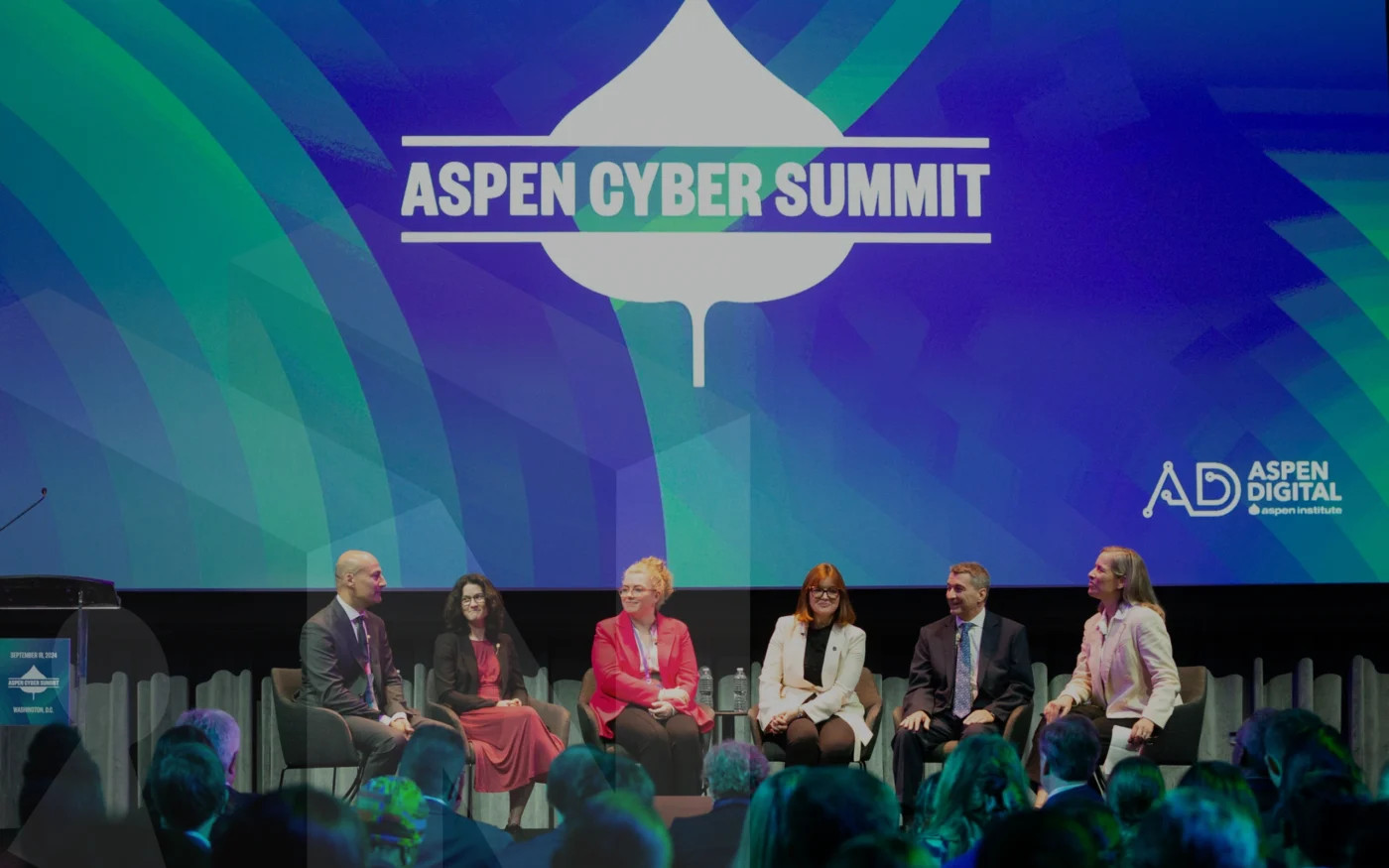
For a decade, one room in Washington has pulled White House officials, four-star generals, Fortune 100 CISOs, and the reporters who cover them all into the same day-long conversation. That room — the Aspen Cyber Summit — is where the US cyber policy agenda often gets articulated publicly before it lands in a strategy document. The 2025 edition, held November 18 at the Kennedy Center’s REACH, was where National Cyber Director Sean Cairncross first previewed the Trump administration’s forthcoming National Cybersecurity Strategy — a document now being socialized across industry and agencies and expected to reframe how Washington thinks about deterrence in cyberspace.
That preview alone would have made the Summit consequential. But the 10th annual gathering was doing something broader: stress-testing the assumption, held since the Obama era, that American cyber posture should lead with defense. Panels on offensive operations, state-level resilience, adversary behavior, AI security, and workforce pipelines all circled the same question — whether the policy architecture built for the last decade is fit for the next one. This piece unpacks what actually got said, who said it, and which signals matter for practitioners watching policy translate into procurement, regulation, and operations.
What the Aspen Cyber Summit Actually Is
The Aspen Cyber Summit is the annual flagship convening of Aspen Digital, a program of the Aspen Institute. Launched in 2016, it positions itself as the nation’s premier annual technology and cybersecurity policy gathering, and the 2025 event marked its 10th year. Roughly 500 attendees from government, industry, and civil society convened in Washington, DC on November 18, 2025, with additional audiences watching the livestream and the session recordings subsequently posted to YouTube.
Unlike a trade show (RSA, Black Hat) or a research conference (USENIX Security, IEEE S&P), Aspen is a policy summit. The agenda is built around fireside chats and panels rather than product launches or technical talks. The currency is access — senior government officials, members of Congress, allied-nation cyber leaders, and Fortune 100 executives sharing a stage and, often, first articulating positions they will later formalize. For working defenders, this is the venue where the regulatory and strategic winds that shape next year’s compliance obligations get named out loud.
The 2025 lineup illustrated the mix. Speakers included General (ret.) Paul M. Nakasone, former Commander of US Cyber Command; Brett Leatherman, Assistant Director of the FBI Cyber Division; Alex Fitzsimmons, Director of the Office of Cybersecurity, Energy Security, and Emergency Response at the US Department of Energy; David Koh, Chief Executive of Singapore’s Cyber Security Agency; Nate Fick, former US Ambassador at Large for Cyberspace and Digital Policy; and Nicole Perlroth, author and venture partner at Ballistic Ventures. Senators Mike Rounds (R-SD) and Gary Peters (D-MI) held a bipartisan fireside, and Morgan Adamski, former Executive Director of US Cyber Command and now US Cyber Leader at PwC, joined Sandra Joyce of Google Threat Intelligence and Leatherman on an offensive-cyber panel.
The Headline: A National Cyber Strategy Built Around Consequences
The most-quoted moment of the Summit came during Cairncross’s fireside with Kevin Mandia, founder of Mandiant and now a general partner at Ballistic Ventures. Cairncross, confirmed by the Senate on August 2, 2025 as President Trump’s principal advisor on national cybersecurity policy, used the stage to sketch the shape of the administration’s forthcoming strategy.
The headline: a new emphasis on imposing costs on adversaries. The upcoming strategy would expand on the existing national cybersecurity strategy, which features five pillars — defend critical infrastructure, disrupt and dismantle threat actors, shape market forces to drive security and resilience, invest in resilience, and forge international partnerships — and add a pillar focused on shaping adversary behavior. Cairncross told the Aspen audience that the US has historically not signaled clearly enough that malicious cyber activity carries consequences, and that this gap has to close as attacks grow more aggressive and AI-accelerated.
The strategy’s form is also deliberate. Cairncross said the document would be a short statement of intent and policy, paired quickly with action items and deliverables — a pointed contrast with the longer Biden-era strategy released in March 2023. He declined to give a release date but said his office is moving as quickly as it can, and Leatherman confirmed that the FBI and other interagency partners had already seen the entirety of the draft.
A second pillar getting heavier weight is regulatory simplification. Cairncross said the government wants industry’s help identifying unnecessary or overly burdensome cybersecurity regulations that could be eliminated or modified, arguing that streamlining would help companies free up resources. The framing matters: where the 2023 strategy leaned toward using regulation to raise the security floor, the 2025 version is being pitched as leaning on partnership and deregulation to raise the ceiling. What replaces prescriptive rules — voluntary frameworks, liability shifts, procurement leverage — is the open question the document itself will have to answer.
Mandia’s contribution was less policy and more operational. He argued that future enterprise defense will resemble sealing compartments in a submarine — instant isolation of breaches to prevent widespread damage — and pointed to more than 2 billion compromised credentials circulating online that attackers can automate and exploit. The submarine metaphor is a concise frame for the segmentation-and-containment architectures (zero trust, microsegmentation, credential-tier isolation) that defenders are already building.
Why Offensive Cyber Dominated the Agenda
The offensive-operations panel — Adamski, Joyce, Leatherman — was the most operationally interesting conversation of the day. The session explored risks and opportunities of offensive actions in cyberspace, the roles of government and the private sector, and the broader toolkit for responding to cyber aggression. That panel, paired with Nakasone’s fireside on China’s cyber evolution, pointed at a real shift in posture.
Cairncross emphasized that deterring malicious activity begins with exposing it, and that the US intends to share more about adversarial behavior and act swiftly to impose real costs on those who undermine American interests in cyberspace. Framed this way, attribution becomes an instrument, not just an after-action artifact. Public naming, indictments, sanctions, and disruption operations work together as a signaling apparatus — one the government has used episodically but, advocates argue, not coherently.
Industry is positioned as a participant rather than a bystander. Leatherman pointed to the strength of current bureau-industry relationships, describing daily intelligence sharing that lends itself to attribution and victim notification. The implication for private-sector defenders: expect more joint advisories, more unsealed indictments referencing specific infrastructure, and more pressure on threat-intelligence vendors to align public reporting with government disruption timing. Whether this dovetails cleanly with private incident response or creates friction — delayed disclosures, gag orders on victims — is something the coming strategy will have to address explicitly.
Nakasone’s China session reinforced the stakes. His remarks traced the evolution of Chinese cyber operations from espionage and intellectual property theft to critical-infrastructure prepositioning and, now, AI-enabled activity — a trajectory that explains why “defense only” no longer satisfies either policymakers or operators on the panel.
The State and Local Story Is the Buried Lede
Cairncross’s keynote pulled most of the press attention, but the Summit’s sustained focus on state, local, tribal, and territorial (SLTT) cybersecurity is arguably more consequential for working defenders. The agenda included a dedicated session on ransomware attacks on schools and hospitals and state-sponsored hacking of water utilities, framing SLTT infrastructure as a major target of cyberattacks.
The policy tension is visible. Programs such as the Multi-State Information Sharing and Analysis Center (MS-ISAC) and the State and Local Cybersecurity Grant Program are both in uncertain times as the federal government shifts more responsibility in the cyber realm to the states. MS-ISAC has been the default shared-services backstop for thousands of county IT shops, school districts, and public utilities for years; funding churn there translates directly to weaker detection and response at the organizations least able to staff a SOC.
For practitioners at smaller municipalities, utilities, and school districts, the Summit’s message was cautiously grim: federal attention is rotating toward adversary-facing work, and state-level resilience will depend more on state budgets, regional collaboratives, and the National Guard cyber units that have emerged as de facto incident responders for governors. The defensive playbook for these environments — credential hygiene, network segmentation, tested backups, vendor risk management — hasn’t changed. What’s changing is how much of the supporting scaffolding (grants, shared tooling, federated threat intel) they can count on.
AI as Both Threat Multiplier and Security Domain
AI threaded through almost every session. The framing split cleanly in two. First, AI as an accelerant for attackers — credential-stuffing at machine speed, polymorphic phishing, automated vulnerability discovery, and the practical erasure of the gap between a posted proof-of-concept and a weaponized exploit. Mandia’s submarine-compartment metaphor lands precisely because attack cycle times are compressing past human decision loops.
Second, AI systems themselves as objects that need securing. Cairncross reinforced that AI security must be built into innovation, not added after the fact, framing it as vital for maintaining US leadership in advanced technologies. That framing is consistent with the broader policy environment — the conversations align with the White House AI Action Plan released in July 2025, which calls for integrating AI development with investments in robust energy systems, privacy-preserving security architectures, and public-sector capacity building.
For operators, this dual framing is already showing up in 2026 roadmaps: SOC teams integrating model-assisted triage while their platform teams wrestle with model and data-pipeline security, prompt-injection defenses, and the identity surface of agentic tooling. The Summit’s contribution was to make clear that federal policy is now treating these as first-class national-security problems, not emerging edge cases.
International Cooperation — and Its Limits
The 2025 Summit gave significant stage time to allied voices. David Koh, Chief Executive of Singapore’s Cyber Security Agency, and Ambassador Brendan Dowling of the Australian Department of Home Affairs represented Indo-Pacific perspectives where threat attribution, intelligence sharing, and joint operational capacity have been maturing rapidly. Nate Fick, former US Ambassador at Large for Cyberspace and Digital Policy under the prior administration, spoke to the continuity and discontinuity between administrations on international cyber engagement.
The subtext was honest. International partnerships remain essential — critical-infrastructure adversaries operate globally, threat intelligence is stronger when it aggregates allied telemetry, and sanctions work best when coordinated. But the partnership architecture built over the last decade — Counter Ransomware Initiative convenings, Five Eyes intel sharing, bilateral cyber dialogues — is being re-examined alongside everything else. What the forthcoming strategy says about international engagement will matter as much as what it says domestically.
The Workforce Conversation That Keeps Repeating
Every cyber policy event has a workforce panel, and every workforce panel reaches roughly the same conclusions. The 2025 Aspen version was more direct than most. Speakers pointed to Israel’s model that combines early technical education, military cyber units, and a dense startup ecosystem, and discussed a proposed US approach including a national cyber academic program. A student-focused panel featuring Dr. Diana Burley, Senior Vice President of Research at The Brookings Institution, challenged conventional wisdom on pathways into the cybersecurity workforce and what skills, education, and experiences matter most.
The uncomfortable observation, made repeatedly on and off stage: the pipeline isn’t broken because of a lack of interested candidates. It’s misshapen — too many four-year programs producing graduates who can’t read a packet capture, too few apprenticeship and military-to-industry bridges, and hiring pipelines that screen out career changers with adjacent skills (intelligence analysis, IT operations, incident response from physical security). Whether the new strategy’s workforce pillar produces anything structurally different from the last three iterations is an open question.
How the Summit Has Evolved — and Why It Still Matters
Ten years is long enough to see the agenda shift. Early Aspen summits were dominated by conversations about whether cyber was a distinct policy domain at all; later ones by the ransomware-plus-critical-infrastructure axis that defined 2020–2023. The 2025 agenda shows a third phase: cyber embedded inside larger geopolitical, economic, and AI debates rather than sitting next to them.
What makes the Summit durable is a product choice. It isn’t a conference where the news happens — it’s a conference where the news gets framed. Officials rehearse positions there before formalizing them. Vendors calibrate messaging. Reporters triangulate. That function is harder to replicate than the speaker list suggests, and it’s why the event continues to punch above its one-day footprint.
FAQ
When and where was the 2025 Aspen Cyber Summit held? November 18, 2025, at the REACH at the John F. Kennedy Center for the Performing Arts in Washington, DC. It was the 10th annual edition, hosted by Aspen Digital, a program of the Aspen Institute.
How do I watch the sessions? All sessions from the 2025 Aspen Cyber Summit are available online via YouTube, including the Cairncross-Mandia keynote and the Nakasone fireside on China’s cyber evolution. The Aspen Digital and Aspen Institute channels host the full recordings.
What’s the difference between the Aspen Cyber Summit and the Aspen Security Forum? Both are Aspen Institute events, but the Security Forum is the broader national-security convening held in Aspen, Colorado each summer. The Cyber Summit is a single-day, DC-based event focused specifically on cybersecurity and technology policy.
When will the new National Cybersecurity Strategy actually be released? Cairncross said the strategy is coming “as quickly as possible” but declined to give a specific timeline at the Summit. As of early 2026, the document has been socialized across interagency partners and reviewed by the FBI but has not been publicly released.
What to Watch For
The real test of the 2025 Summit isn’t what got said on stage — it’s which of those positions become durable policy. Three markers to track: the release and specific language of the new National Cybersecurity Strategy, particularly how the “shape adversary behavior” pillar translates into authorities and named operations; the fate of SLTT-supporting programs like MS-ISAC and the State and Local Cybersecurity Grant Program as federal-state cost-shifting accelerates; and whether regulatory streamlining produces actual rescissions and harmonization or plateaus at a set of non-binding guidance updates.
For practitioners, the operational priorities don’t really change on the strength of a policy speech: identity hygiene, segmentation, tested backups, visibility into OT and SaaS environments, and a credible response plan remain the work. What the Summit clarified is the direction of the policy current around that work — more public attribution, less prescriptive regulation, more pressure on industry to partner with the government on disruption, and a continued reckoning with AI as both a tool and a target. The next year will show whether the direction holds.